Rolling Downhill
Table of Contents
A couple of weeks ago, I was at a Y Combinator event hosted for Waterloo students interested in entrepreneurship. I asked the YC partners Boris Jabes and Andrew Miklas a pretty honest question along the lines of: I feel like I’m lazy when it comes to school and work, but motivated with other “less important” things I find interesting. How do I know if I’ll have the motivation and discipline needed to start a company? Their two answers resonated and helped me crystallize my theory for how to be prolific and accomplish great things.
Find Interesting Challenges #
Andrew’s answer was essentially that hard work becomes easy once you find the right challenge to work hard on. There is no lazy/not lazy dichotomy; it just depends on what you’re working on. Once you find the right thing you want to be doing, showing up every day is no longer an uphill battle but something natural.
I find that I am far more prolific and successful when I let myself roll, maintain my momentum, and do what is most interesting to me during that season of life. In the past, that has led me to create vlogs with thousands of views or write debating guides that have been read by students worldwide. Currently, the most interesting work to me is building a cross-platform app.
A common concern against this approach is that you end up too well-rounded and with no spikes. However, being a generalist is highly applicable in complex contexts such as startups, where one faces multifaceted challenges. Skills from one area are often cross-applicable in insightful ways in another, and different contexts teach you to think through problems from unique perspectives.
When I learned about pipelining in operating systems, the analogy of laundry cycles was helpful: washing the next load while the previous load is still in the dryer maximizes efficiency. In a debate about the effects of private equity in pharmaceutical research, this helped me reason that pharma companies trial multiple drugs simultaneously, all in various stages of the approval pipeline. This means that there would be no good time for PE firms to pull out their investment, as ongoing promising trials are still in the pipeline that may yield high returns.
Following your interests not only makes you well-rounded, but it can also give you multiple spikes. I think of this as rolling downhill— once you find the right slope, momentum takes care of the rest.
Shorten the Feedback Loop #
Boris’s answer was to shorten the feedback loop. Humans are complex, but at our core, we seek rewards. The more immediate the reward, the more likely we are to do an action!
When I analyze the things I enjoy doing most, I find a pattern that these activities all have short feedback loops. When you debate, you focus and prepare arguments, and within an hour, deliver them to an audience for ranking. In rock climbing, you receive instant feedback every time you grab a new hold or shift your weight a certain way. When producing music, every time you change a melody and play it back, you immediately feel whether it was an improvement or not.
This insight means you can design your work to be more rewarding, such as doing more project-based learning! Rather than reading a textbook or taking a course that awards a certification at the end, I prefer to get my hands dirty with Claude Code and a side project. If I’m hooking up a new platform in code, I’ll establish the shared database first so that I can work with live data and immediately see results while developing it. When I enter a new codebase, fixing a bug is a faster way to gain new context than reading the documentation.
Motivation comes easier, and results come faster when you shorten the feedback loop. Combined with Andrew’s advice of finding interesting challenges, you arrive at the concept of rolling downhill: following your passions and what’s most engaging.
What Rolling Downhill Actually Looks Like #
I knew rolling downhill was true because training for debate felt effortless, even though it was a lot of hard work. I really enjoyed working with my debate partner, Advait, relistening to speeches to see what worked and what didn’t, and setting a clear goal of being a top 48 team advancing to elimination rounds (also known as breaking) at the World Championship.
But I almost didn’t get there. Being in STEM at Waterloo, debate is considered niche and unimportant compared to Leetcode grinding and job applying. My friends and family didn’t understand why I spent weekends competing and occasionally discouraged me. Though I was good at debate, I never fully committed to improving during university due to guilt about wasting my time on something unproductive.
Around a year ago, after a disappointing result at the North American championship, a judge named Ayal gave us an animated hour-long talk about how we were excellent but lacked discipline. I cried in the stairwell during the break night party as I realized I had been letting myself down by not working harder. The next day, I created my matter file, and prep for Worlds officially began.
I wanted to not live up to my potential, because that meant that I had potential. Except it turns out that you do fail if you don’t try, both literally and figuratively. — John Green
This quote embodied my mindset for the next 8 months.
I researched world affairs during our lunch breaks, spent evenings at various public libraries studying online seminars, and attended countless midnight online comps from Advait’s apartment on weekends, implementing feedback from judges and more experienced debaters. While on exchange in Singapore, I got moulded into a more well-rounded debater at NUS practices thanks to the strong and distinct speakers from Asia.
Advait and I subsequently made history with a successful performance at the World Championship, becoming the first Waterloo team to break at Worlds since 1991.
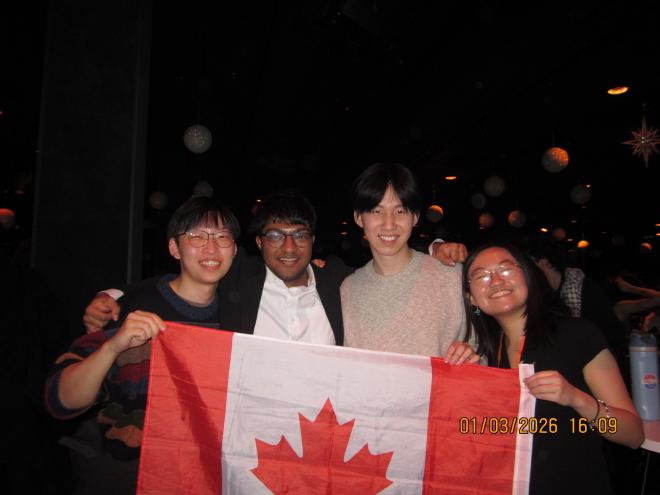
Now, I believe pursuing passions and trying fearlessly can lead to extraordinary outcomes. But if you asked me today to get back to grinding Leetcode questions every day and taking the safe route, there would be a huge amount of friction, and I would probably burn out pretty quickly. Take the leap of faith— even if you fail, you’ll enjoy the process of doing what you love.
Establishing Principles #
What is success? In the past, my happiness came from achievements, but this meant failure led to outsized disappointment, and success was only a temporary win. So, many years ago, I established a personal set of principles that redefine success. I remind myself of these daily, such as making the world a better place and building a strong, interdependent, authentic community. This way, I can find fulfillment as long as my work aligns with my principles, regardless of outcomes. This helps overcome the “hedonic treadmill”, where each achievement just makes you want the next bigger, better thing more.
What you surround yourself with is deeply important, illustrated by sayings like “you are what you eat” and “you’re the average of your five closest friends.” These days, this is also true of our digital diet, which subliminally shapes us, so I try to keep my inputs aligned with my principles and interests. The content I consume inevitably shapes my thinking, so I try to consume what I want to think more about (e.g., international news or philosophy). For instance, watching the vlogbrothers taught me about the worldwide fight to eradicate tuberculosis, which became the inspiration for an award-winning hackathon project I made.
Debate is a perfect example of finding principle-defined success. Even though Waterloo’s culture told me it was a waste of time, because it aligned with my principles around community, growth, and doing meaningful work, I found it rewarding. I find fulfillment in helping build our club through marketing work, training up-and-coming debaters the way I was trained, and acting as a Chief Adjudicator at this year’s edition of the North American championship, where I first learned the lesson of living up to my potential a year ago.
In a TEDx talk I did in high school, I referred to competitive debate as a mountain to climb for those willing to take on the challenge. But after the question I asked at YC a fortnight ago, I realized that it was more of a hill for me to roll down. I’m not lazy— I just need the right hill. And when I find it, I go all the way.